
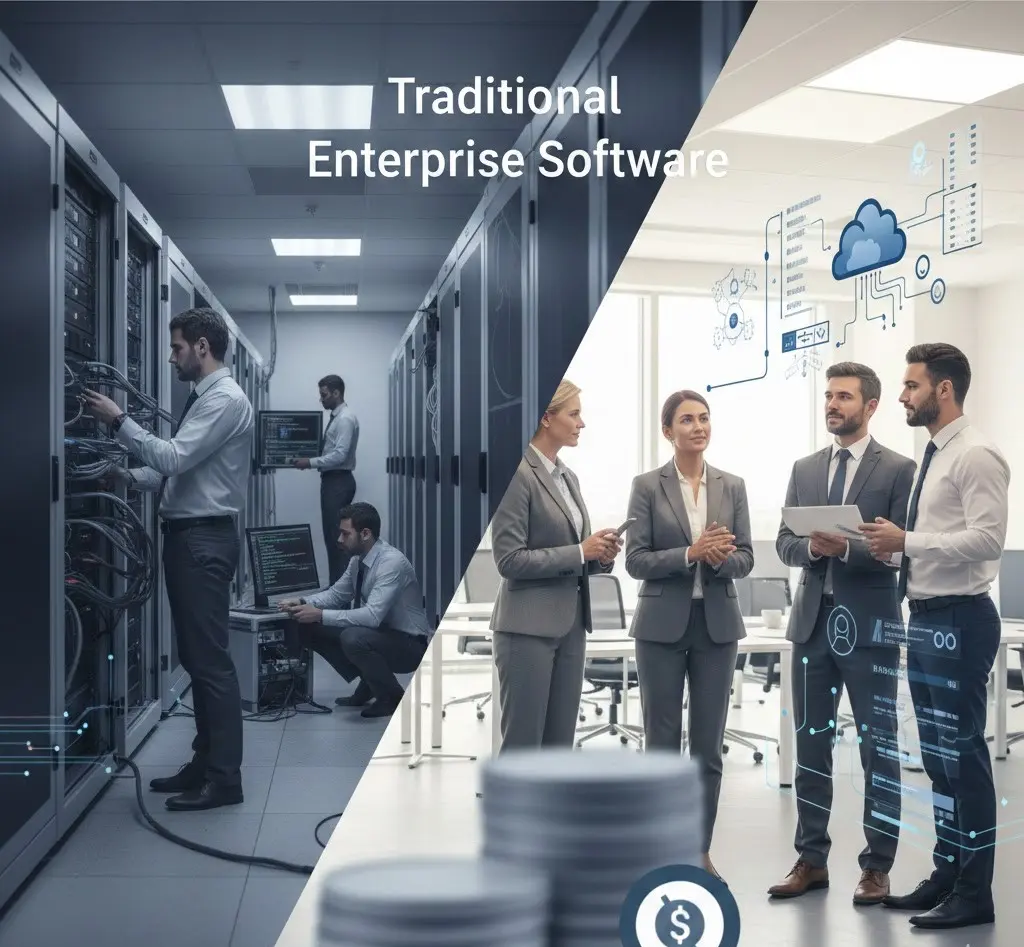
The Real Difference Between Enterprise SaaS and Traditional Software
The distinction isn’t about cloud versus on-premise anymore. That’s a deployment detail. What separates enterprise SaaS from traditional software is operational responsibility. When you license traditional software, you own the infrastructure burden—servers, updates, patches, security hardening, disaster recovery. When you adopt enterprise SaaS platforms, the vendor assumes that operational overhead in exchange for recurring fees and reduced control.
Large companies make this choice based on where they want to allocate internal resources. If your IT team is managing aging infrastructure instead of supporting digital initiatives, you’re losing competitive capacity. I’ve watched manufacturing groups delay product launches because their ERP upgrade required six months of testing. That calculus changes when software updates happen automatically without shutting down production systems.
Scalability and Organizational Growth
Why Traditional Software Struggles as Companies Grow
Traditional enterprise software was designed for predictable scaling. You purchased licenses for a known user count, provisioned hardware accordingly, and hoped growth stayed within projected ranges. When companies acquire subsidiaries, enter new markets, or restructure divisions, those assumptions break down.
The real constraint isn’t technical capacity—it’s change velocity. Adding new business units to a traditional system means procurement cycles, hardware lead times, integration projects, and testing windows. I’ve seen retail chains take eighteen months to bring acquired store locations onto their core systems because the licensing model and infrastructure requirements created compounding delays.
How Enterprise SaaS Supports Multi-Department Expansion
SaaS platforms eliminate most scaling friction by abstracting infrastructure from headcount. Need to onboard 200 users across three countries? That’s a configuration change, not a capital project. The advantage isn’t just speed—it’s predictability. Finance teams can model growth without estimating server costs, data center capacity, or IT staffing requirements.
This matters more as organizational complexity increases. When you’re coordinating software access across regional subsidiaries with different compliance requirements, SaaS administration becomes substantially simpler than managing distributed infrastructure.
Cost Structure: Capital Expenses vs Long-Term Operational Costs
Upfront Licensing vs Subscription-Based Models
Traditional software required capital expenditure approval. That meant business case presentations, ROI projections, and executive sign-off on investments that might exceed seven figures. Enterprise SaaS shifts this to operational expense, which flows through different budget approval processes and doesn’t require the same level of financial scrutiny.
CFOs generally prefer OpEx models because they align costs with usage and reduce balance sheet complexity. But the real benefit for large companies is budget flexibility. When you’re not locked into multi-year capital commitments, you can redirect spending based on changing priorities without writing off sunk infrastructure costs.
Hidden Costs Companies Frequently Underestimate
Neither model is cheap once you account for total cost of ownership. Traditional software hides ongoing costs in maintenance contracts, upgrade projects, and internal administration. SaaS hides them in integration complexity, user tier limitations, and the compounding expense of subscription growth.
I’ve watched companies migrate to SaaS expecting cost reduction, then discover they’re spending more after factoring in API development, data warehouse connectors, and premium support tiers required for SLA guarantees. The cost advantage comes from operational efficiency, not necessarily lower absolute spend.
Deployment Speed and Business Agility
Large companies adopt enterprise SaaS because implementation timelines compress dramatically. Traditional software deployments routinely take twelve to eighteen months from procurement to production. Enterprise SaaS can be operational in weeks for standard configurations.
That speed differential matters when business conditions change faster than IT can respond. Logistics firms implementing new customer portals, regional banks launching digital lending products, or healthcare systems integrating telehealth capabilities—these initiatives can’t wait for traditional software procurement cycles.
The trade-off is customization depth. SaaS platforms push you toward standard workflows, which forces process standardization across the organization. Some companies view this as a limitation. Others see it as an opportunity to eliminate departmental inefficiencies that accumulated over decades.
Security, Compliance, and Risk Management
Large companies accept SaaS risk because their alternative is managing security internally with limited resources. Most enterprises lack the depth of security expertise that major SaaS vendors maintain. When you’re competing with nation-state threat actors, a dedicated vendor security team becomes more defensible than internal IT staff handling security as a secondary responsibility.
Compliance complexity actually favors SaaS in regulated industries. Financial services firms, healthcare organizations, and government contractors need audit trails, data sovereignty controls, and certification documentation that SaaS vendors build into their platforms. Creating equivalent capabilities internally requires ongoing investment that many companies can’t justify.
The risk isn’t eliminated—it’s transferred. You’re trusting vendor controls instead of managing them directly, which requires rigorous vendor assessment and contract negotiation around data handling, breach notification, and liability terms.
Integration with Existing Enterprise Systems
At scale, no software operates independently. Your CRM needs data from ERP. Your analytics platform pulls from finance, HR, and operations. Your planning systems integrate with supply chain and sales forecasting.
Enterprise SaaS succeeds or fails based on integration capability. Companies choose platforms with established connector ecosystems and API maturity because integration complexity determines whether the system delivers value or creates data silos. I’ve seen well-chosen SaaS platforms fail because integration requirements exceeded the vendor’s capabilities or the company’s implementation resources.
Traditional software often has deeper integration potential through direct database access, but that flexibility comes with technical debt as customizations accumulate.
When Traditional Software Still Makes Sense
SaaS isn’t universal. Companies with extreme data sovereignty requirements, highly specialized workflows, or operations in restricted jurisdictions still need traditional deployments. Defense contractors, certain financial institutions, and industrial companies with proprietary processes often can’t accept SaaS constraints.
When your competitive advantage depends on software differentiation that no vendor will build, custom traditional software remains the better option despite higher operational burden.
Final Perspective
Large companies choose enterprise SaaS when operational efficiency and deployment speed outweigh customization control. It’s a strategic bet that vendor-managed infrastructure delivers better outcomes than internal IT operations for commodity business functions. That calculation depends on industry, competitive positioning, and internal IT capability—not industry trends or vendor marketing.
