
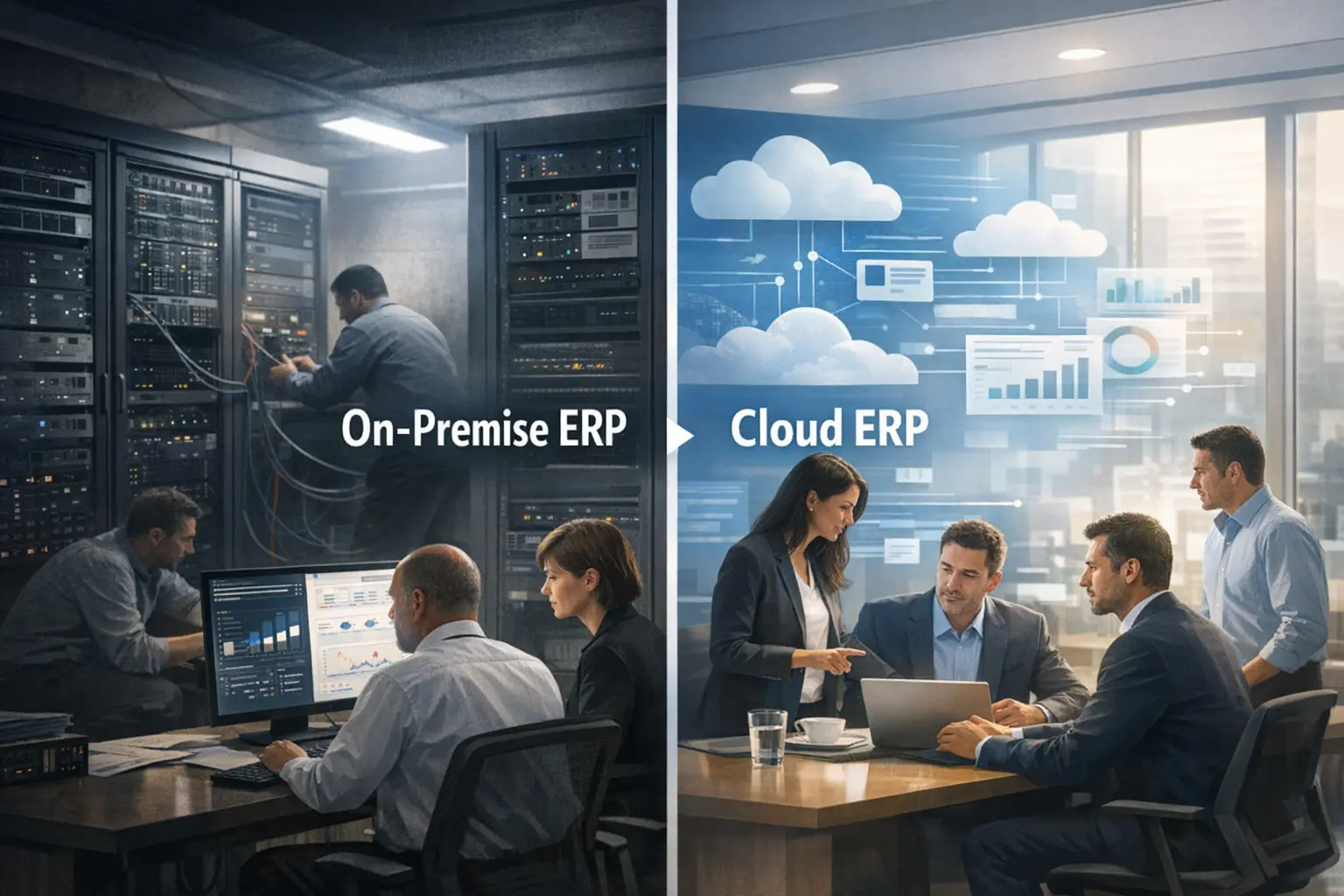
The decision between cloud and on-premise ERP deployment has evolved considerably from the binary choice it appeared to be five years ago. I’ve advised organizations through both paths, and the reality is more nuanced than vendor positioning suggests. The question isn’t which approach is categorically superior—it’s which aligns with your organization’s operational priorities, risk tolerance, and strategic direction.
In 2026, this choice carries different implications than it did even two years ago. Cloud maturity has reached a point where security and compliance objections that once drove enterprises toward on-premise are now addressable. Simultaneously, the total cost calculus has shifted as cloud pricing models evolved and infrastructure economics changed.
I’m writing this after guiding multiple large organizations through deployment strategy decisions and living with the operational consequences of those choices. This isn’t theoretical comparison—it’s what actually happens when you run enterprise operations on these platforms.
The State of ERP Deployment in 2026
Market adoption has tilted decisively toward cloud, but not as uniformly as analyst reports sometimes suggest. Approximately 65% of new ERP implementations in large enterprises now deploy cloud-first, but that still leaves substantial on-premise activity, particularly in specific industries and scenarios.
The shift isn’t driven by technology fashion. It reflects genuine changes in enterprise priorities and capabilities.
Organizational IT departments face different pressures than they did a decade ago. The mandate to reduce infrastructure footprint, accelerate time-to-market, and enable remote operations has intensified. Cloud deployment addresses these pressures more directly than traditional on-premise approaches. A multinational manufacturer I worked with moved to cloud ERP specifically to enable operational flexibility during pandemic disruptions—the ability to scale capacity and support remote finance teams became more valuable than infrastructure control.
Vendor strategies have converged around cloud economics. SAP’s shift toward S/4HANA Cloud, Oracle’s Fusion Cloud, Microsoft’s Dynamics 365—these aren’t alternative offerings. They’re the strategic direction where development investment flows. On-premise options remain available, but product roadmaps, feature velocity, and support ecosystems increasingly favor cloud deployments.
This creates subtle pressure on organizations considering on-premise: you’re choosing a deployment model where innovation will be slower, feature parity will lag, and vendor attention will be divided.
Emerging challenges center on integration complexity and vendor lock-in concerns. Cloud platforms promise simplicity but deliver it through standardization that constrains customization. Organizations with complex, differentiated processes often discover cloud deployment requires more process reengineering than anticipated. The question becomes whether that standardization represents beneficial simplification or loss of competitive capability.
Vendor lock-in anxiety has intensified as organizations realize cloud ERP creates dependencies that on-premise deployments don’t. When your business processes run on vendor-controlled infrastructure with proprietary APIs and data models, switching costs become prohibitive. I’ve watched organizations struggle with this tension: seeking cloud agility while fearing long-term inflexibility.
Operational Trade-Offs Between Cloud and On-Prem
Control vs Vendor Responsibility
The fundamental trade-off is operational control versus operational burden.
Cloud ERP shifts infrastructure responsibility to the vendor. Server capacity, database performance, backup procedures, disaster recovery, security patching—these become the vendor’s problem. For organizations with limited IT resources or those seeking to redirect technical staff toward business-focused projects, this shift represents genuine value.
A healthcare system I advised migrated to cloud specifically to eliminate data center management. Their IT team of 40 people was spending 60% of their time on infrastructure maintenance. Cloud deployment freed capacity to focus on system optimization and user support. The CFO calculated this reallocation delivered more value than the operational cost savings.
But you surrender control over the environment. Upgrade timing, feature availability, performance tuning parameters—these follow vendor schedules and priorities, not yours. One financial services client struggled when their cloud ERP provider scheduled a major upgrade during their fiscal year-end close period. The vendor offered limited flexibility because the upgrade affected multi-tenant infrastructure serving hundreds of customers.
On-premise deployment maintains complete operational control. You determine upgrade schedules, performance configurations, customization scope, and integration architecture. This autonomy matters when your business cycles, regulatory requirements, or operational complexity demand it.
A defense contractor operates on-premise ERP specifically to maintain control over timing. Their production schedules, security clearance requirements, and contractual obligations create constraints that cloud deployment timelines can’t accommodate. They manage infrastructure burden because operational autonomy is non-negotiable.
The hidden cost of on-premise control is expertise retention. You need staff who understand database administration, server infrastructure, network architecture, and application-specific technical details. As cloud skills become market standard, finding and retaining personnel with deep on-premise expertise becomes progressively more difficult and expensive.
Deployment Speed and Business Agility
Cloud implementations typically reach production faster. Infrastructure provisioning that takes weeks or months on-premise happens in days with cloud deployment. A retail client went from project kickoff to pilot deployment in four months with cloud ERP—a timeline that would have been twelve to fifteen months on-premise once you account for hardware procurement, data center preparation, and environment configuration.
This speed advantage compounds when scaling to additional geographies or business units. Adding production capacity for a new region in cloud deployment often requires configuration changes and user provisioning. On-premise requires physical infrastructure, network connectivity, potentially new data centers or server capacity.
But deployment speed doesn’t automatically translate to business value realization. The complexity of process design, data migration, testing, and user adoption remains identical regardless of deployment model. I’ve seen organizations achieve fast cloud deployment but struggle for months afterward because they rushed through requirements definition and change management.
Process agility differs between models in subtle ways. Cloud platforms enable rapid experimentation—spin up test environments, prototype new workflows, validate changes without significant infrastructure investment. This encourages iterative improvement and faster adaptation to business changes.
On-premise environments create friction around change. Environment provisioning takes longer. Testing cycles extend because infrastructure constraints limit parallel testing capacity. Organizations often become conservative about changes because the overhead of validation is higher.
A logistics company operating cloud ERP prototypes process improvements monthly, implements successful experiments rapidly, and abandons unsuccessful ones without significant sunk costs. Their on-premise predecessor required formal project approval, extended testing cycles, and created organizational resistance to experimentation because the overhead was substantial.
Cost Considerations: CapEx vs OpEx
Upfront Investment and Licensing Models
The financial structure of cloud versus on-premise deployment creates fundamentally different budget dynamics.
On-premise ERP requires substantial capital investment. Software licensing, hardware infrastructure, data center facilities, network infrastructure—these costs concentrate at project initiation. For a mid-sized enterprise, initial investment often ranges from $5-15 million depending on scope and complexity.
This capital intensity creates budget hurdles but also accounting advantages. The investment becomes a depreciable asset. IT organizations with available capital budgets but constrained operating budgets sometimes prefer on-premise specifically because of financial classification.
Cloud ERP converts capital costs to operational expenses. No hardware purchases, no data center buildout, no upfront infrastructure investment. Instead, you pay subscription fees based on users, transaction volume, or consumed capacity. Initial costs focus on implementation services, data migration, and organizational change management.
For a comparable implementation, cloud deployment might require $2-4 million upfront—substantially less than on-premise—but creates ongoing operational costs of $1-3 million annually in subscription fees.
The five-year total cost of ownership often converges between models, but the cash flow timing differs dramatically. Organizations with capital constraints or those seeking to preserve balance sheet flexibility increasingly favor cloud’s operational expense model. Private equity-backed companies particularly prefer cloud deployment because it reduces upfront capital requirements and converts fixed costs to variable expenses that scale with business performance.
Ongoing Operational and Hidden Costs
Annual maintenance for on-premise ERP typically runs 18-22% of license fees. But that’s just vendor support. Add internal IT staff for database administration, infrastructure management, backup operations, and disaster recovery planning. Include data center costs—power, cooling, physical security, network connectivity. Factor in periodic hardware refreshes as servers age.
A manufacturing client calculated their true annual operational cost for on-premise ERP at 35% of initial capital investment when fully loaded with all infrastructure and personnel costs. This exceeded their cloud alternative’s subscription fees, but they maintained on-premise because specific operational requirements justified the premium.
Cloud subscription costs are more visible but create their own complexity. User-based pricing seems straightforward until you’re managing thousands of users across multiple license types—full users, limited users, read-only access, API connections. Consumption-based pricing for storage, integrations, or transaction processing creates variable costs that spike unpredictably.
One retail client experienced a 40% increase in cloud ERP costs during peak season because their transaction volume triggered higher pricing tiers. The contract structure they’d agreed to during implementation didn’t account for seasonal business fluctuations. Negotiating better terms required contract renewal, leaving them absorbing unexpected costs for eighteen months.
Hidden costs affect both models but differ in character. On-premise implementations often underestimate ongoing customization maintenance, upgrade complexity, and technical debt accumulation. Cloud deployments discover costs in integration middleware, third-party connectors for legacy system compatibility, and premium support tiers necessary for production operations.
The organizations that manage costs effectively treat deployment choice as a multi-year financial model, not a point-in-time comparison. They account for scaling scenarios, growth projections, and operational evolution. They test pricing models against realistic usage patterns rather than accepting initial quotes as representative of long-term costs.
Security, Compliance, and Risk Management
Security and compliance considerations have evolved significantly as cloud platforms matured and regulatory frameworks became more sophisticated.
Data sovereignty and regulatory compliance once represented the primary barrier to cloud ERP adoption. Organizations in regulated industries—financial services, healthcare, government contractors—defaulted to on-premise because they needed absolute control over data location and access.
That landscape has shifted. Cloud providers now offer region-specific deployments, data residency guarantees, and compliance certifications for major regulatory frameworks—SOC 2, ISO 27001, HIPAA, FedRAMP, GDPR. A financial services client successfully migrated to cloud ERP while maintaining compliance with banking regulations by selecting deployment in specific geographic data centers with contractual data residency guarantees.
But compliance complexity remains. Multi-jurisdictional operations create scenarios where different data must reside in different regions, subject to different regulatory requirements. Cloud providers support this, but configuration complexity increases substantially. One multinational manufacturer operates a hybrid model specifically because compliance requirements across their operating countries couldn’t be satisfied by a single cloud deployment region.
Threat management and security responsibility differs between models in ways that favor different organizational capabilities.
Cloud providers invest in security infrastructure at scale that individual enterprises can’t match—dedicated security operations centers, threat intelligence teams, automated intrusion detection, continuous vulnerability scanning. For organizations without sophisticated security capabilities, this represents significant risk reduction.
But you’re trusting vendor security practices and accepting shared responsibility models where certain security aspects remain your obligation—user access management, application-layer security, data classification. Organizations must understand exactly where vendor responsibility ends and theirs begins.
On-premise deployment places complete security responsibility on the organization. This provides control but requires maintaining security expertise, infrastructure, and operational rigor. As threat sophistication increases, the cost and complexity of effective security operations grows substantially. Smaller IT organizations increasingly struggle to maintain security capabilities comparable to major cloud providers.
Real operational risk trade-offs often come down to organizational maturity and industry context.
A defense contractor operates on-premise because their security clearance requirements and classified data handling needs can’t be satisfied by commercial cloud providers. The operational burden is justified by compliance necessity.
A healthcare system chose cloud specifically because their internal security capabilities couldn’t match cloud provider infrastructure. They experienced fewer security incidents post-migration because vendor security operations exceeded what they could maintain internally.
The decision isn’t which model is more secure in absolute terms. It’s which aligns security capabilities with organizational requirements and risk tolerance.
Scalability and Organizational Growth
Cloud ERP Advantages for Multi-Region Expansion
Geographic expansion reveals cloud deployment’s most compelling operational advantages. When a company enters new markets, acquires businesses in different regions, or scales internationally, cloud infrastructure eliminates traditional deployment friction.
A technology company I advised expanded from North American operations to Asia-Pacific markets in eight months. Cloud ERP enabled this pace—new users provisioned remotely, infrastructure capacity scaled automatically, regional customization deployed through configuration rather than infrastructure buildout. The equivalent on-premise deployment would have required regional data centers, local IT staff, and twelve to eighteen months minimum.
Scaling user populations happens elastically with cloud deployment. Add 500 users for a new business unit? Provision licenses and configure access. On-premise might require server capacity expansion, database performance tuning, network infrastructure upgrades—changes that take weeks or months to plan and implement.
But scaling creates cost implications that organizations sometimes underestimate. User-based subscription pricing means growth directly increases operational costs. A company that doubles in size through acquisition faces immediate doubling of cloud subscription fees. On-premise infrastructure might accommodate significant user growth without proportional cost increases.
Cloud deployment enables operational models that on-premise struggles to support. Distributed workforces, remote operations, temporary capacity for seasonal business—these scenarios leverage cloud elasticity naturally. Companies with highly variable operational rhythms benefit substantially from infrastructure that scales with demand.
On-Prem Challenges with Rapid Scaling
Infrastructure capacity planning becomes the primary constraint in on-premise scaling scenarios. You’re forecasting growth, sizing infrastructure, and making capital commitments based on projections that might prove inaccurate.
Over-provision and you’ve invested capital in unused capacity. Under-provision and you face expensive emergency expansions when growth exceeds projections. One manufacturing client experienced this painfully—they scaled production faster than anticipated, overwhelmed ERP infrastructure capacity, and faced a six-month emergency hardware procurement and installation cycle that created operational disruptions.
Geographic distribution requires physical presence. New regions mean new infrastructure, local IT support, network connectivity across sites. This creates fixed costs and deployment timelines that limit organizational agility.
A retail client expanding internationally maintained on-premise ERP but the operational friction was substantial. Each new country required infrastructure assessment, compliance validation, local technical resources, and six to nine months deployment. They eventually migrated to cloud specifically because international expansion became a strategic priority that on-premise deployment couldn’t support at the required pace.
The organizations that succeed with on-premise scaling plan infrastructure conservatively, budget for periodic capacity expansions, and accept that growth creates stepped capital investments rather than smooth operational scaling.
Integration with Existing Enterprise Systems
ERP deployment choice significantly affects integration architecture and operational complexity.
Cloud ERP platforms typically offer extensive pre-built connectors for other cloud applications—Salesforce, Workday, ServiceNow, major analytics platforms. Integration through standard APIs and middleware platforms like MuleSoft, Dell Boomi, or native integration services reduces custom development requirements.
But integration with legacy on-premise systems creates complexity. A financial services company operating cloud ERP discovered integrating with their on-premise loan origination system required custom middleware, VPN connectivity, and ongoing maintenance that exceeded initial estimates by 60%. The cloud platform integrated seamlessly with other cloud apps but struggled with legacy infrastructure that predated modern API architectures.
On-premise ERP integration provides complete flexibility—you control the integration architecture, middleware choices, and custom development approach. This matters when integrating with proprietary systems, legacy applications, or specialized industry platforms.
A manufacturing client with decades of accumulated operational technology—MES systems, quality management platforms, custom engineering tools—maintained on-premise ERP specifically because integration requirements exceeded what cloud platforms supported through standard connectors. They needed low-latency, high-volume data exchange with manufacturing equipment that cloud-based integration couldn’t reliably deliver.
Hybrid architectures are increasingly common—cloud ERP integrated with a mix of cloud and on-premise applications. This provides operational flexibility but creates integration complexity that requires sophisticated middleware and ongoing architectural management.
One organization operates cloud ERP, on-premise warehouse management, cloud CRM, and legacy manufacturing systems. Their integration layer has become a critical operational component requiring dedicated technical staff and continuous maintenance. The architecture works, but the complexity exceeds what they anticipated during initial cloud migration planning.
When On-Prem Still Makes Sense
Despite strong market momentum toward cloud, specific scenarios continue to favor on-premise deployment.
Highly regulated industries with stringent data control requirements sometimes can’t satisfy compliance obligations through commercial cloud platforms. Defense contractors handling classified information, certain healthcare providers managing sensitive patient data, financial institutions operating under specific regulatory frameworks—these organizations maintain on-premise ERP because compliance necessity outweighs operational efficiency considerations.
A government contractor operates entirely on-premise specifically because security clearance and data classification requirements can’t be met by commercial cloud infrastructure. They accept the operational burden because no alternative exists.
Organizations with highly customized, proprietary processes that represent competitive differentiation often prefer on-premise control. When your ERP embodies operational processes that competitors can’t replicate, cloud platform standardization represents risk.
A specialty manufacturer with decades of process optimization in custom workflows maintains on-premise ERP because migrating to cloud would require either abandoning proprietary processes or extensive customization that defeats cloud operational advantages. They’ve calculated that their process differentiation delivers more competitive value than cloud agility would provide.
Industries with extreme performance requirements—high-frequency manufacturing, real-time logistics optimization, complex supply chain orchestration—sometimes require infrastructure control that cloud deployment can’t guarantee. Latency sensitivity, throughput requirements, or integration with operational technology favors on-premise architecture.
Capital availability and accounting preference drives some decisions. Organizations with available capital budgets but constrained operational budgets prefer the asset creation that on-premise represents. This is often less about technology and more about financial structure and organizational budget dynamics.
The organizations that choose on-premise successfully in 2026 make the decision deliberately, understanding they’re accepting operational complexity in exchange for specific capabilities that cloud deployment can’t deliver at acceptable cost or risk.
Final Perspective: Choosing the Right Strategy for 2026
The cloud versus on-premise decision in 2026 isn’t a referendum on which deployment model is categorically superior. It’s a strategic alignment question: which approach matches your operational priorities, risk tolerance, financial structure, and organizational capabilities?
Cloud deployment makes sense when:
Operational agility and deployment speed are strategic priorities
Geographic expansion or scaling are anticipated
IT resources should focus on business value rather than infrastructure management
Capital preservation and operational expense models align with financial strategy
Security and compliance requirements can be satisfied through vendor capabilities
On-premise deployment remains appropriate when:
Regulatory or security requirements demand infrastructure control
Highly customized processes represent competitive differentiation that cloud standardization would compromise
Performance requirements or operational technology integration needs favor infrastructure control
Capital availability and accounting structure prefer asset investment
Organizational IT capabilities can maintain infrastructure expertise and operational rigor
The hybrid reality is that many large organizations operate both models—cloud ERP for certain functions or regions, on-premise for others. This creates architectural complexity but provides operational flexibility that pure strategies don’t deliver.
What’s essential is making the choice deliberately, based on clear operational priorities rather than vendor positioning or technology fashion. The organizations that succeed with either deployment model understand what they’re optimizing for and accept the trade-offs inherent in their choice.
Cloud isn’t inevitably the right answer. Neither is on-premise. The right answer is the deployment strategy that aligns with how your organization operates, where it’s headed strategically, and what capabilities matter most for competitive success. That analysis requires honest assessment of organizational maturity, realistic evaluation of operational requirements, and clear-eyed understanding of what you’re gaining and what you’re surrendering with either choice.
In 2026, both paths remain viable. Choose based on operational reality, not market momentum.
